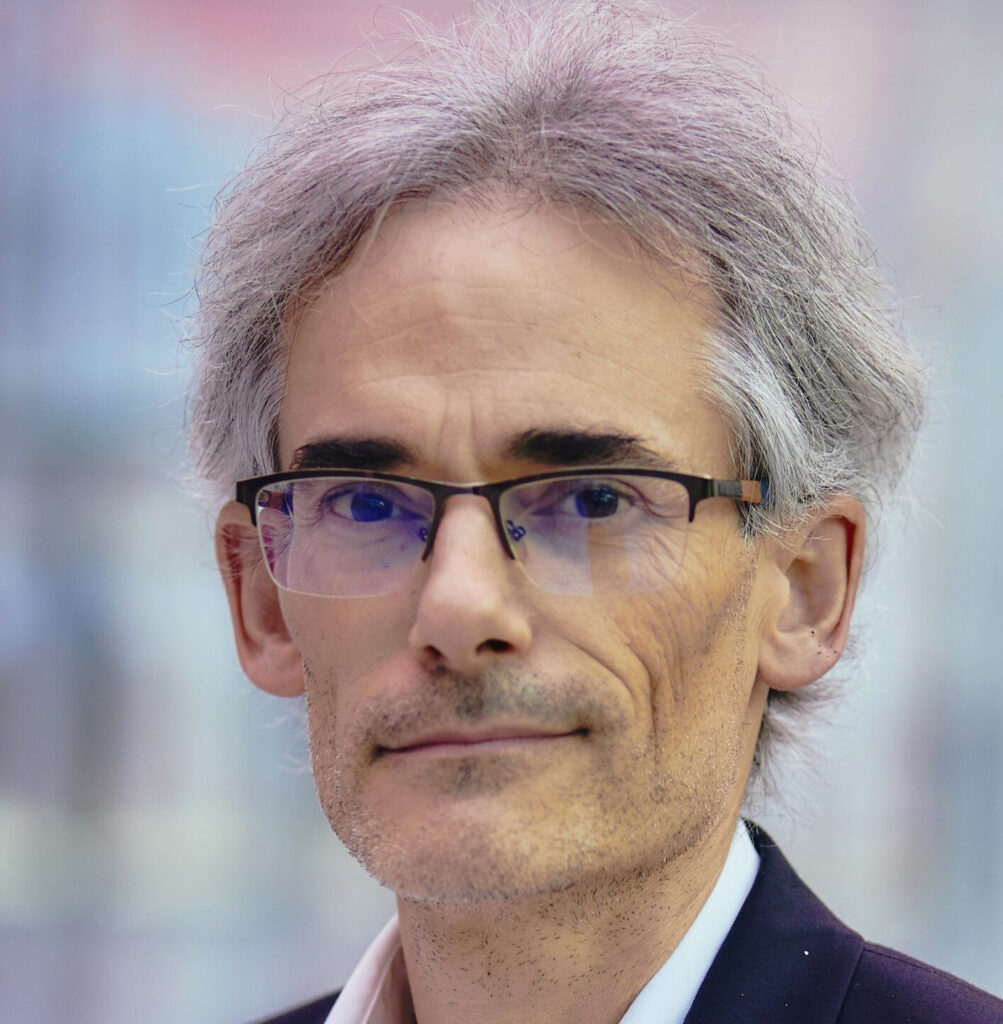



-1st meeting-16/05/2024: at the first GFIN meeting, each group members gave a short presentation of their researches on fault (Detailed program)
-2nd meeting-24/06/2025: at this second GFIN meeting, round tables have been organized to discuss potential comon interests and develop research project together.
9h30-10h: accueil/café
10-12h30: “La notion de cycle sismique”
11h- Anne Socquet: Imager la subduction et sa dynamique dans les Andes: En quoi la subduction de chaines océaniques contrôle la déformation, la sismicité et les circulations de fluides ?
12h30-14h: lunch.
14h-16h30: “L’imagerie d’un grand système de failles”
+ work done by Fabrice Taty presented by Guillaume Caumon “Interprétation de failles sur des images sismiques”
16h30: beers
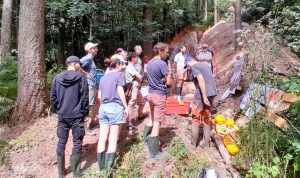
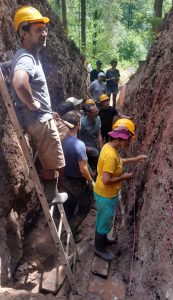
-3rd meeting – July 7, 2026: Field trip to the Relanges Fault. During this one-day excursion, around ten members of the group visited Relanges to examine and observe a trench excavated across a normal fault by Jérôme Van der Woerd and Nicolas Cathelin from ITES.
-5/11/2024 à 13h au CRPG: Mathieu Soret (ENS Paris) – Etude expérimentale des mécanismes physico-chimiques contrôlant l’évolution des interfaces de plaques du cycle sismique au cycle orogénique (300-800°C).
Résumé: Les déformations le long des interfaces de plaques tectoniques concentrent l’essentiel des transferts de matière et d’énergie intervenant dans le recyclage élémentaire entre les enveloppes internes et externes de la Terre. L’observation des interfaces actives et fossiles indique que cette localisation extrême est régie – du cycle sismique au cycle orogénique – par des transformations physico–chimiques réduisant drastiquement la résistance des roches et favorisant les circulations de fluide dans des roches essentiellement imperméables. Cependant, la nature exacte de ces transformations demeure mal quantifiée. En conséquence, ces dernières ne sont toujours pas intégrées dans les modèles thermo-mécaniques, même les plus sophistiqués, ce qui limite fortement notre capacité à prédire les déformations et les transferts de matière en profondeur.
Mes travaux de recherche ont donc pour objectif de mieux contraindre les mécanismes physico-chimiques contrôlant l’évolution des roches en réaction, depuis les interfaces des minéraux jusqu’à celles des plaques tectoniques et pour des durées allant du cycle sismique au cycle orogénique. Les principales questions posées sont : 1) comment les réactions, via les propriétés thermodynamiques de leurs constituants, contrôlent-elles les déformations sismiques et asismiques profondes ?, et 2) comment les mécanismes de déformation et les champs de contraintes aux limites contrôlent-ils les interactions fluide–roches et les processus réactionnels associés ?
Pour résoudre ces questions, je m’appuie sur des expériences de déformation à haute pression (2.1 GPa) et haute température (850°C) sur une presse Griggs de nouvelle génération qui révèlent que les déformations opèrent par fluage réactionnel (dissolution-précipitation) à des contraintes bien inférieures à celles prédites dans les modèles thermo-mécaniques actuels. L’accommodation des déformations et des transferts de matière sont favorisés par des circulations de fluide transitoires résultant de mouvements aux joints de grains, de fracturation intense et de réaction de densification. A plus grande échelle, ces nouveaux résultats éclairent les mécanismes cassants et visqueux qui sous-tendent la formation des zones de cisaillement crustales. Ils montrent notamment que l’initiation et le développement des interfaces de plaques sont principalement contrôlés par des changements physico-chimiques transitoires enracinés dans le déséquilibre chimique des roches sous contraintes.
-24/06/2025 à 11h au CRPG: Anne Socquet– Imager la subduction et sa dynamique dans les Andes: En quoi la subduction de chaines océaniques contrôle la déformation, la sismicité et les circulations de fluides ?
-1/07/2026 and 2/07/2026: 2nd journées failles – https://journee-faille.sciencesconf.org/
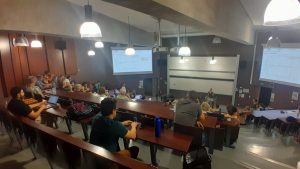
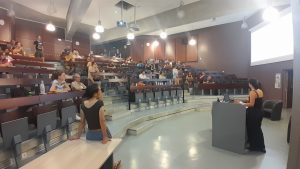
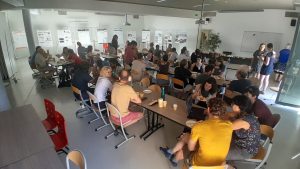
The 1st and 2nd of july 2026 we organized in Nancy at the Ecole des Mines the 2nd “Journées faille”. Our aim wasto bring together, over two days, all scientists and professionals in France working on fault-related topics across disciplines and not only on active faults. We welcome researchers, faculty members, students, engineers, and technical staff involved in fault studies in fields such as (non-exhaustive list): Mechanics / Rheology, Geodynamics, Seismology, Paleoseismology, Fault dating (e.g., U–Pb), Petrography, Geodesy (GNSS, InSAR), Structural geology, Deformation quantification (morphotectonics, balanced cross-sections, etc.). The workshop was hosted at the École des Mines de Nancy near the city center. About 65 people attended to the meeting with 27 presentations, 7 invited talk and 10 posters. We organized 5 differents sessions including sismology, geology and geochemestry, numerical and annalog modeling and seismic hazard.
Off-fault aseismic deformation (Simon Daout, Julien Charreau, Jérôme Lavé)
In active tectonic regions, the temporal succession of earthquakes on fault-related folds is considered the primary mechanism driving the formation of piedmont topography. Geomorphological markers left behind by these structures have recorded, over the long term, the number and magnitude of past ruptures. However, surface geodetic displacements measured during earthquakes are sometimes difficult to reconcile with the cumulative deformation recorded by these markers (e.g., Daout et al., 2021; Fielding et al., 2004; Marinière et al., 2020). Furthermore, the recent discovery of aseismic deformation occurring before or after earthquakes raises questions about the role of off-fault aseismic deformation in the growth of fault-related folds (Fig. 1B). To address this, structural and geomorphological studies are being conducted on several folds where aseismic displacements have been measured, and kinematic modeling is being carried out. The study areas are located in the Qaidam Basin in the northeastern Tibetan Plateau, the southern piedmont of the Tianshan Mountains, and the Tajik Basin in Tajikistan.
Quantification of Structural Uncertainties by Downscaling Tomographic Models (Paul Cupillard, Guillaume Caumon)
Although advances in data acquisition, computational power, and automated interpretation techniques have improved seismic imaging, detecting fine-scale geological structures such as faults remains challenging due to the physical limitations of seismic data. Because seismic data are band-limited, the resolution of the images they provide is also finite, and the interpretation of geological structures is therefore inherently uncertain. These uncertainties limit our understanding of ithospheric dynamics at all scales and increase the financial risks associated with subsurface exploitation projects. To quantify structural uncertainties, we propose a downscaling method for models obtained through Full Waveform Inversion (FWI). Based on inverse non-periodic omogenization, this method makes it possible to generate a large number of fine-scale models that are compatible with the considered FWI model, thereby enabling the estimation of uncertainties in fault geometry and displacement. Since the problem is ill-posed, it is formulated within a Bayesian framework and solved using an MCMC-type algorithm. The latter randomly generates velocity models
using a kinematic approach for fault parameters and geostatistical simulations for the fine-scale layering of the velocity model.
3D Kinematic Model of Fault Networks (Guillaume Caumon)
The objective of the project is to advance the state of the art in modeling displacements associated with fault networks. The idea is to define a small number of geometric parameters capable of describing discontinuous displacement in the near field of a fault network, while accounting for branch lines and fault interactions. Once the numerical displacement model has been developed, the method will be tested on benchmark interpretations derived from high-resolution 3D seismic datasets. Following this initial validation, the proposed parameterization could be used to generate training data for AI-based seismic interpretation. In this context, an interesting question will be whether such an extended training database can improve interpretation in tectonically complex areas compared with state-of-the-art machine learning methods. Another research avenue will be to jointly estimate the location of the fault network and the slip parameters from subsurface data. This could be investigated by extending existing inversion methods developed for individual faults to incorporate interpretation points (Godefroy et al., 2018) or full-waveform inversion results (Ruggiero et al., 2026).